Buying a Cordless Power Cleaner? Check These 5 Things
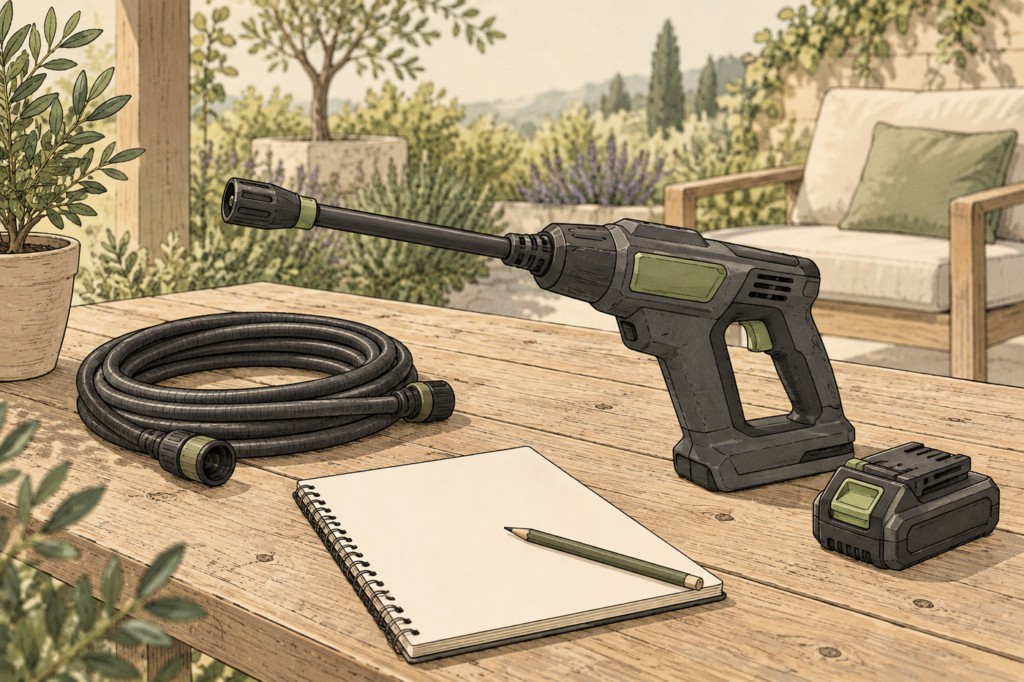
Before buying a cordless power cleaner, check its water supply, pressure and flow information, included parts, battery setup, and intended tasks. Those five details tell you whether the model fits your situation and what else you’ll need.
Start with a concrete job, such as rinsing outdoor furniture where you plan to use it. A description like “portable” leaves several questions unanswered: where the water comes from, which accessories connect, and whether the selected package is ready for your setup.
Cover: AI-generated editorial illustration of generic equipment. It is not a SEESE product photo, package checklist, or performance demonstration.
1. Confirm the water supply this model accepts
Write down the water source available at the job location. Then check the cleaner’s instructions for the approved supply, required hose, connection, and any intake components. A product being cordless describes its power connection; it doesn’t tell you how it receives water.
Some portable cleaners have documented options for drawing water from a container, but that capability must be specified for the model. For example, the DEWALT DCPW550 manual describes its garden-hose and suction-hose setups. Those instructions apply to that model and do not establish the supply options for a SEESE cleaner.
If you plan to work away from a faucet, confirm the full water-supply arrangement before ordering. A hose pictured in a listing does not, by itself, prove a self-drawing or bucket-fed setup.
2. Read pressure and flow specifications together
Pressure and water flow describe different parts of a cleaner’s output. On US product pages, pressure is commonly stated in PSI and flow in GPM. Copy the manufacturer’s labels exactly, including whether a figure is rated, maximum, or tied to a particular mode.
Compare like-for-like values when possible. A maximum-pressure headline and another model’s rated-pressure figure aren’t equivalent labels. If the conditions or units are missing, mark the comparison incomplete rather than treating the larger number as a winner.
Keep a copy of each specification and its source beside your comparison notes. When a listing provides no output figure, record it as unconfirmed. This guide does not supply a pressure or flow rating for SEESE.
3. Check what the selected package includes
Make a list of everything required by the model’s instructions, then compare it with the selected package. Include the nozzle, hose, connections, and any water-supply accessories. Put batteries and charging equipment on the same list.
Use the written package description for the selected option. A photo may show accessories that are available separately or belong to another configuration. When the wording is unclear, get the package confirmed before placing an order.
Do not assume a foam attachment or hose from a different cleaner will work. Both the connection and the model’s operating requirements matter.
4. Match the battery and charger to the cleaner
Record the exact cleaner, battery, and charger models. Check whether the package includes the required battery and charging equipment or whether you already own confirmed compatible items. Matching a voltage printed on two products is not enough to establish compatibility.
For SEESE replacements, use the battery and charger compatibility checklist. A shared brand name does not replace a model-specific confirmation.
If runtime matters to your job, request a figure with its battery, mode, and test conditions. A capacity label alone does not tell you how long an untested setup will clean. Avoid estimating a whole-car or whole-patio workload from that label.
5. Match the intended task to the model’s instructions
Describe the surface and what you want to remove. Rinsing loose debris from garden equipment is a different request from tackling a large area of deeply stained pavement. Compare your task with the manufacturer’s stated applications and limits.
The SEESE cordless portable power cleaner is described for rinsing vehicles, garden equipment, and outdoor furniture. The listing identifies a cordless handheld design and a 6-in-1 nozzle. It does not provide pressure or runtime figures.
Confirm the selected battery, charger, hose, and water-supply requirements. Follow the exact model’s instructions and the surface manufacturer’s care guidance for operation. A listed vehicle application is not a guarantee for every coating, finish, or spray setup.
Your cordless power cleaner buying checklist
| Check | Record | Decision |
|---|---|---|
| Water | Your available source and the model’s required supply. | Match confirmed, or supply details still needed? |
| Output | Pressure, flow, units, and conditions when provided. | Comparable figures, or an incomplete comparison? |
| Package | Required parts and the selected option’s contents. | Included, already owned, or must be obtained? |
| Power | Cleaner, battery, and charger model numbers. | Compatibility confirmed, or pending? |
| Task | Surface, cleaning goal, and supporting instructions. | Documented application, or further confirmation needed? |
Example setup: You’re considering a cleaner for patio furniture, but the work area has no faucet nearby. Resolve the water-supply question first. If the model doesn’t document your intended arrangement, a convenient battery setup alone doesn’t settle the purchase. This is a planning scenario, not a product test.
Questions before buying
Can every cordless cleaner draw from a bucket?
No universal capability follows from the word “cordless.” Confirm the model’s approved water sources and required components. For the SEESE listing discussed here, the specific supply requirements are a pre-purchase check.
Does a 6-in-1 nozzle tell me the pressure?
The number of nozzle settings does not establish an output rating. Look for a separate pressure specification with its conditions. The SEESE product lists a 6-in-1 nozzle but does not provide a pressure figure to compare.
Is a portable cleaner a replacement for any pressure washer?
Decide from the model’s documented output, compatible accessories, and intended tasks. Category names do not establish equivalent performance. If your job has specific requirements that the listing doesn’t answer, get those resolved before selecting a model.
Your next step: Review the cleaner’s specifications and package details alongside your checklist. For a different job, browse cleaning and car-care tools by task.
About this guide: Prepared for SEESE from current product information and the linked manufacturer example. It contains no SEESE pressure, flow, runtime, or comparative cleaning test.